
Free HSE tool · Planning & Permits
Lifting Plan
The lifting plan — the Lifting Operations and Lifting Equipment Plan, the LLOP — is the document for the lift: the load, the crane, the method, the site, the people, and the classification that sets how much planning the lift needs. A lift that is classified special and planned as basic is the lift the investigation calls a planning failure.
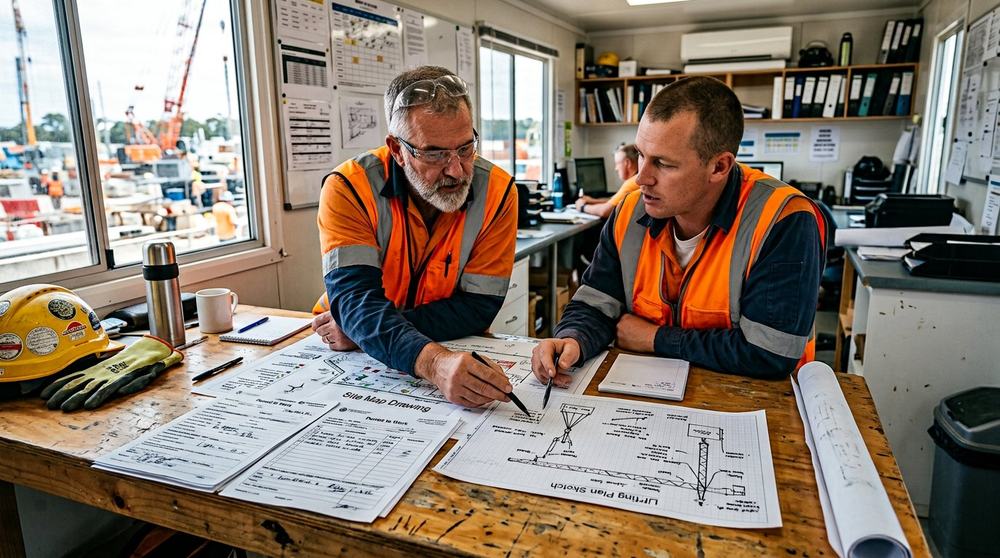
Free Lifting Plan (LLOP) — with Automatic Classification
Enter the lift — the tool classifies it (basic, complex, special) and shows the checklist for the class. The 75% utilisation rule is built in.
Classification criteria (tick what applies)
Checklist for the class
Method statement
Site survey
People (competency, not just names)
Use the tool below: enter the lift details, and the classification is automatic from the criteria — basic, complex or special — with the checklist for the class. Complete the method statement and the site survey, and print the plan. The classification criteria are the UK LOLER and the HSE L113/INDG103 practice, and they are the same logic the US and the Gulf use with their own standards.
How to use the tool
- Enter the lift details — the load and the weight, the crane and the capacity at the radius, the radius, the date, the location
- Read the classification — the tool applies the criteria: basic, complex or special, and shows the checklist for the class
- Complete the method statement — the sequence, the rigging, the signals, the exclusion, the communication
- Work the site survey — the ground, the services, the overhead, the weather, the proximity
- Assign the people — the lift supervisor, the crane supervisor, the dogman, the rigger, the crane operator: the competency, not the name — then print the plan
Worked example
An 18-tonne transformer to the substation pad: the crane the 40-t all-terrain at the 12-m radius (the chart: 22 t at 12 m — the 82% utilisation), the load 18 t with the rigging, the method the single pick and place, no pick and carry. Classification: the special criterion is met — the utilisation is over 75%: the lift plan signed by the competent person, the method statement with the rigging and the signals, the ground bearing confirmed (the matting laid), the exclusion set and the barrier, the weather the wind limit 9.8 m/s, the communication the radio, the people the licensed operator, the trained rigger and the dogman, the lift supervisor the sites competent person. The plan is printed, the method is briefed, the lift is supervised from the start. The 82% is the number the plan exists for.

Standard & legal context
The UK Lifting Operations and Lifting Equipment Regulations 1998 (LOLER) require the lifting operation to be properly planned by a competent person, properly supervised, and the equipment inspected; the HSE L113 ACoP and the INDG103 set the classification — the basic, the complex and the special. The US pair is the OSHA 1926.1420 (the crane and derrick) and the ASME B30.5, with the lift-plan practice from the API and the construction industry. The classification criteria on this page are the UK practice, and the logic — the weight, the radius, the utilisation, the proximity, the pick and carry, the tandem — is the same worldwide.
Common mistakes
- Classifying by the weight and not the total picture — the 10 t load that is the pick and carry near the crowd is the special, not the basic; the criteria are read together, not one-of
- No ground bearing check — the crane on the soft ground is the collapse that is not the cranes fault on the chart; the matting and the survey are the plan
- The exclusion as a cone of honour — the exclusion is the barrier, the dogman, the no-entry, and the communication; the everyone-knows exclusion is the one that fails
- The plan written and not briefed — the plan is the document the crew works from; the method statement read to the rigging crew is the plan that happens
Need the sign-off, not just the tool?
The tool is the preparation; the sign-off is the professional. For the statutory assessments, the audits, the ISO 45001 implementation and the training that comes with them, ask Muhammad Umer — 8+ years across Iraq, KSA and Pakistan, and the programme runs through umer-hse.pro. One message gets the written scope.
Common questions
Lifting Plan — answered
What is a lifting plan?
The LLOP — the document for the lift: the load, the crane and the capacity, the method, the site, the people and the classification. LOLER requires the lifting operation to be planned by a competent person; the plan is the evidence, and the classification sets the depth of the planning.
What is the difference between basic, complex and special lifts?
Basic: the standard lift, under the thresholds, no special features — the plan is the standard. Complex: over a threshold or a feature (the weight, the radius, the proximity, the multiple cranes) — the full plan. Special: the pick and carry, the tandem, the over-75% utilisation, the crowd proximity, the critical infrastructure — the competent persons signed plan, the method statement, the supervision. The tool classifies automatically.
Who writes the lifting plan?
The competent person for the lifting operation — the site lift supervisor or the crane company engineer for the special lifts. The competence is the knowledge and the experience of the lift, and the signature is the accountability; the plan is not the operators document.
What is the 75% utilisation rule?
The practice that the lift over 75% of the cranes rated capacity at the radius is the special classification — the margin is the safety, and the 75% is the line where the margin is not enough for the standard planning. The chart is the cranes, and the 75% is the classification criterion.
Do I need a lifting plan for every lift?
LOLER: the planning is for every lifting operation; the depth is by the classification. The basic lift has the standard plan (the check, the chart, the method); the complex and the special have the full document. The no-plan-needed lift is the one the investigation calls the un-planned lift.
Can I print the lifting plan?
Yes — the Print button produces the plan: the details, the classification with the criteria met, the method statement, the site survey, the people and the sign-off. It is the document the lift supervisor holds on the day and the investigation opens when the lift goes wrong.
Keep building
Related tools
Job Safety Analysis (JSA/JHA)
Free job safety analysis tool: break the job into steps, list the hazards, existing controls, add new controls
Planning & PermitsPermit to Work (PTW)
Free permit to work forms: hot work, confined space, electrical, working at height and cold work
Planning & PermitsWork at Height Survey
Free work at height site survey: the access, the equipment, the anchor points, the weather, the rescue plan an
THE HEALTH AND SAFETY is an education and knowledge network. The tools are free and open; the professional assessments and audits run through umer-hse.pro.
Safety disclaimer
These tools are practical guidance, built to the UK baseline with the US equivalents named on each page. They do not replace a competent person assessment for high-risk work, a statutory assessment, or the advice of your insurer. Where a document has legal force — the fire risk assessment, the COSHH register, the permit to work — the responsible person owns it. Use the tool as the preparation, and the competent person as the sign-off.