
Toolkit · 5 tools
Planning & Permits
The high-risk work is controlled before it starts, and the control is the plan: the lifting plan with the classification that sets its depth, the permit to work with the gas test that checks itself, the method statement, and the emergency plan that is drilled, not filed.
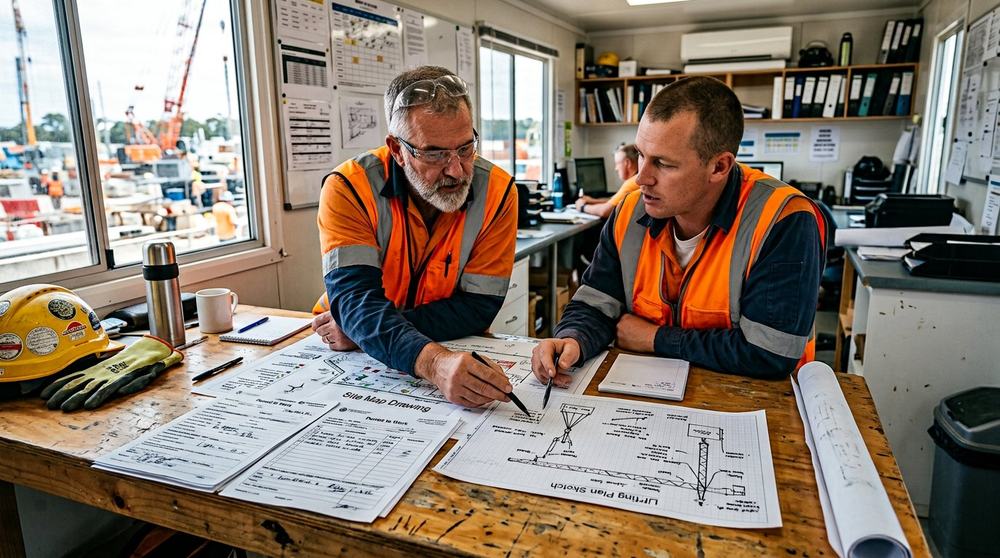
The high-risk work is controlled before it starts, and the control is a plan: the lifting plan with the classification that sets its depth, the permit to work with the controls per type and the live gas test, the confined space checklist with the isolation and the rescue, the work at height survey with the weather and the rescue check, and the emergency action plan with the drill log. The category is the pre-start controls — the documents that make the high-risk task a managed one.
The order is the point: the lifting plan classifies the lift before the crane moves, and the permit is issued after the isolation is done, not before. The confined space checklist is the entry that holds — the gas test at the entry and at depth, the attendant with the sole duty, the rescue that is drilled, not written. The work at height survey is the one that moves the task a day when the wind is over the limit, and that is the survey working. The emergency action plan is the one the drill log proves — the clear time against the target, the issues closed, the warden and the backup named. A permit that is a rubber stamp is worse than no permit, because it is the evidence of a control that did not happen; the 20-point system audit on the PTW page is the check that the permits you issue still mean something.
Every tool in this category works the same way: it runs in your browser, it scores or checks as you go, nothing is uploaded, and it prints as a signed, dated document you can file. The professional version — the sign-off, the audit, the training — runs through umer-hse.pro.
Planning is the difference between a task and an operation. The job safety analysis breaks the task into steps, finds the hazard in each step, and writes the control against the step — it is the plan for the hands. The method statement is the plan for the job: the scope, the sequence, the resources, the controls, the emergency, and the sign-off chain — it is the document the auditor reads and the crew works from. The construction phase plan sits above both in construction work, under the CDM Regulations 2015, where the principal contractor owns the sequence and the interface. The OSHA side reaches the same place through the job hazard analysis and the site-specific safety plan.
The test of the plan is simple: could a new person, with the plan and no other information, do the task safely? If the answer needs a supervisor standing over them, the plan is missing the step. The three things that fail plans most often are the interface — where two trades or two systems meet, the energy moves and the plan has to say who owns it — the emergency, which is written as a sentence and not a step — and the change, which the plan does not cover because the work changed and the paper did not.
The tools in this section are the working plans: the JSA template with the steps and the controls, the method statement with the sign-off chain, and the pre-task planning that fits the toolbox talk. The templates are in the Resources, the risk assessment that feeds the plan is in the Toolkit, and the professional preparation for the high-risk work runs through umer-hse.pro.
- The JSA is the plan for the hands; the method statement is the plan for the job
- The interface is the first place the plan fails — name who owns the energy where the systems meet
- Write the emergency as a step, not a sentence
- The changed task needs the changed plan — the paper follows the work

5 tools
The Planning & Permits range
Permit to Work (PTW)
Free permit to work forms: hot work, confined space, electrical, working at height and cold work
Planning & PermitsConfined Space Checklist
Free confined space entry checklist: the permit, the live gas test (O2, LEL, CO, H2S) with the limits, the iso
Planning & PermitsLifting Plan
Free lifting plan (LLOP) tool: the lift details, the automatic classification (basic, complex, special), the m
Planning & PermitsWork at Height Survey
Free work at height site survey: the access, the equipment, the anchor points, the weather, the rescue plan an
Planning & PermitsEmergency Action Plan
Free emergency action plan template: the assembly points, the evacuation routes, the roles (the warden, the fi
Not sure which tool fits your job? Ask Muhammad Umer — one conversation maps the tool to the task.
Safety disclaimer
These tools are practical guidance, built to the UK baseline with the US equivalents named on each page. They do not replace a competent person assessment for high-risk work, a statutory assessment, or the advice of your insurer. Where a document has legal force — the fire risk assessment, the COSHH register, the permit to work — the responsible person owns it. Use the tool as the preparation, and the competent person as the sign-off.