
Free HSE template · Risk Assessment Templates
Issue-Based Risk Assessment Template
The issue-based risk assessment template flips the usual document on its head: instead of one assessment per room, it is one per task or issue. The moving of the heavy load, the cleaning of the tank, the welding in the bay — each is its own assessment, because the hazard is in the task, not the walls.

Issue-Based Risk Assessment — one document per task
The task in the header, the hazards of the task, the controls for the moment, the score and the sign-off. Carried on the job, filed when done.
| Hazard of the task | Who is exposed | L | C | Score | Control for the task | Owner | Done? |
|---|
It is the format the non-routine and the high-risk tasks need, and the one that sits next to the JSA on the job. The task is named in the header, the hazards are the hazards of that task, and the controls are the controls for that moment. Print it, carry it on the job, and file it signed.
How to use the template
- Name the task or issue in the header — the moving, the cleaning, the welding, the specific job
- Set the location, the date, the task owner, the preparer
- List the hazards of the task, not the room — what can go wrong in this task
- Score likelihood and consequence for the task as it stands
- Add the controls for the task in hierarchy order and re-score
- Sign it, brief the crew, carry it on the job, and file it when done
Worked example
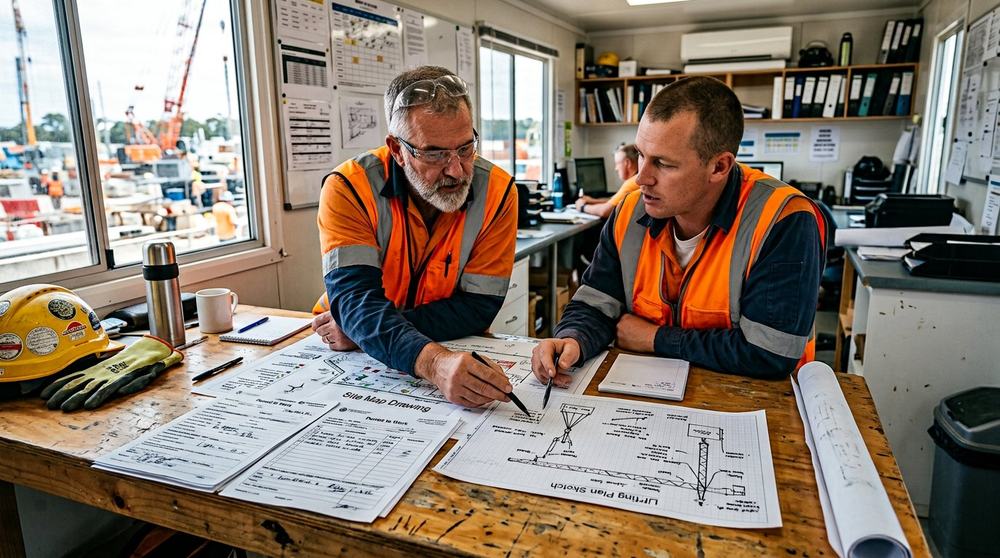
An issue-based assessment for the transfer of the 18-tonne transformer: the task named, the hazards the overload (the utilisation at 82%), the ground bearing, the overhead line, the load in the air; the pre-control scores high; the controls the matting, the survey, the de-energised line, the exclusion; the residual reduced; the sign-off by the competent person. One task, one document, carried on the job.
Standard & legal context
The issue-based template is the five-step method applied per task, the format OSHA uses for the non-routine and the permit-required work and the one that sits with the JSA and the permit to work. It meets the MHSWR 1999 assessment duty at the task level and the ISO 45001:2018 clause 6.1.2 hazard identification for the work activity. Where the task is permit-required, this assessment is the companion to the permit, not the replacement for it.
Common mistakes
- Assessing the room and calling it the task — the issue-based document is the task, and the room hazards live in the area assessment
- One document for every task — the routine task gets the assessment once and a periodic review; the non-routine one gets one every time
- No sign-off by the task owner — the document is carried on the job, and the sign-off is the accountability
- Using it as a replacement for the permit — the permit-required task carries both, the assessment and the permit
Need the sign-off, not just the template?
The template is the preparation; the sign-off is the professional. For the statutory assessments, the audits, the ISO 45001 implementation and the training that comes with them, ask Muhammad Umer — 8+ years across Iraq, KSA and Pakistan, and the programme runs through umer-hse.pro. One message gets the written scope.
Common questions
Issue-Based Risk Assessment Template — answered
What is an issue-based risk assessment?
A risk assessment written per task or issue instead of per room: the task named in the header, the hazards of the task, the controls for the task, the score and the sign-off. It is the format for the non-routine and the high-risk work.
How is it different from the general risk assessment?
The general assessment is per workplace or area; the issue-based is per task or issue. The same five steps, different scope. The area assessment covers the room; the issue-based covers the job.
When do I use an issue-based risk assessment?
For the non-routine, the high-risk and the permit-required tasks — the moving, the cleaning, the welding, the entry. The routine task is assessed once and reviewed; the non-routine one is assessed every time.
Is it the same as a JSA?
They are close cousins and often used together: the issue-based is the risk assessment of the task, the JSA is the step-by-step breakdown of the task. On a complex job the JSA is the sequence and the issue-based is the risk and the controls.
Can I use it with a permit to work?
Yes — for the permit-required task the issue-based assessment is the companion to the permit. The permit authorises the task; the assessment is the risk and the controls. Both are filed together.
Can I print or export it?
Yes — Print / Save as PDF gives the document to carry on the job, and Export CSV gives the lines for your file. The template is built to be done before the task, not after.
Keep building
Related templates
JSA / JHA Template
Free JSA template (job safety analysis / job hazard analysis): the steps, the hazards, the existing controls,
Risk Assessment TemplatesGeneral Risk Assessment Template
Free risk assessment template you can print and fill in: the 5 steps, the 5×5 scoring, the action plan and the
Operations & IncidentPermit to Work Template
Free permit to work template: the header, the controls per work type, the gas test, the sign-off and the 20-po
THE HEALTH AND SAFETY is an education and knowledge network. The templates are free and open; the professional assessments and audits run through umer-hse.pro.
Safety disclaimer
These templates are practical documents, built to the UK baseline with the US equivalents named on each page. They do not replace a competent person assessment for high-risk work, a statutory assessment, or the advice of your insurer. Where a document has legal force — the fire risk assessment, the COSHH register, the permit to work — the responsible person owns it. Use the template as the preparation, and the competent person as the sign-off.