
Article · Workplace Safety · 27 August 2026
Toolbox Talk Examples: 10 Ready-to-Use Topics With the Structure
A toolbox talk without a topic is the minute; a toolbox talk with a topic is the method. This article is the ten topics the site runs on — the slips, the forklift, the confined space, the electrical, the manual handling, the heat, the LOTO, the PPE, the housekeeping, and the near miss — each one structured on the four lines: the task, the hazards, the controls, the emergency, with the two questions that make it a conversation. Print one, sign the sheet, and the talk is done.
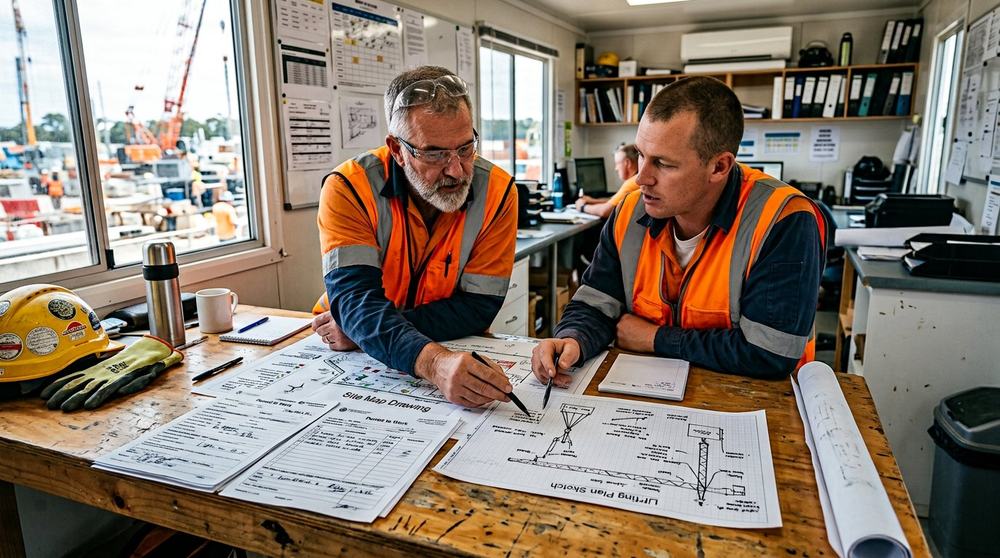
The structure every topic runs on
Every toolbox talk example in this article runs on the same four lines, and the four lines are the method. Line 1 — the task: what the crew is doing, the scope, the sequence. Line 2 — the hazards: the hazards of the task, the specific risks. Line 3 — the controls: the control that is in place, and the one that is not. Line 4 — the emergency: the alarm, the assembly, the first aider, the contacts.
And the two questions that make it a conversation: what do you see as the hazard on this task? and what are you most worried about on this shift? The questions are the instrument that carries the sight of the crew, and the sight is the hazard the supervisor has not seen. The ten topics below are the ten conversations, structured on the four lines, ready to run.
The sign-in is the line that makes the talk a record: the topic, the date, the location, the presenter, the attendees, the signatures, the actions. The sheet is the document the client asks for, and the trend is the review. The ten topics, the four lines, the two questions, the sign-in — the method, ten times.
Topic 1 — Slips, trips and falls
The task: the shift, the routes, the work at the point of work. The hazards: the wet floor, the cable on the route, the step that is not marked, the housekeeping. The controls: the mat at the wet point, the cable tied or ramped, the step marked, the housekeeping before the shift ends. The emergency: the first aider, the contacts, the assembly. The questions: where is the wet point on this shift? what is on your route that is not on the list? The sign-in: the sheet, the signatures, the action (the mat, the tie, the mark).
Topic 2 — Forklift and pedestrian interface
The task: the deliveries, the racking, the dock. The hazards: the reversing, the blind spot, the pedestrian at the dock, the speed. The controls: the spotter at the dock during the peak, the one-way route, the speed limit, the segregation of the pedestrian, the horn at the bend. The emergency: the stop, the barrier, the first aider, the contacts. The questions: where is the blind spot on this route? what is the worst near miss you have seen here? The sign-in: the sheet, the signatures, the action (the mirror at the blind spot).
Topic 3 — Confined space entry
The task: the inspection of the vessel, the tank, the pit. The hazards: the atmosphere (the O2, the LEL, the toxic), the engulfment, the escape, the communication. The controls: the permit, the gas test before and during, the attendant, the rescue plan and the equipment, the communication fixed, the PPE. The emergency: the rescue, the alarm, the first aider, the EMS. The questions: who is the attendant, and where? what is the rescue plan, and has it been drilled? The sign-in: the sheet, the signatures, the permit reference, the action (the drill).
Topic 4 — Electrical and LOTO
The task: the panel service, the machine maintenance, the isolation. The hazards: the arc flash, the stored energy, the re-energise, the wrong source. The controls: the LOTO applied and verified (the try-out), the arc-flash PPE for the rating, the insulated tools, the exclusion set, the sequence of the re-energise. The emergency: the stop, the first aider, the contacts, the EMS. The questions: who applied the lock, and who verifies? what is the rating of the panel, and is the PPE for it? The sign-in: the sheet, the signatures, the action (the rating check).
Topic 5 — Manual handling
The task: the carton, the casting, the bag, the load. The hazards: the weight, the distance, the height, the repetitive, the awkward. The controls: the team lift, the trolley, the vacuum lifter, the rotation, the technique (the load close, the back straight). The emergency: the first aider, the contacts. The questions: what is the heaviest load on this shift? where is the awkward one? The sign-in: the sheet, the signatures, the action (the lifter, the rotation).
Topic 6 — Heat stress
The task: the outdoor work, the hot bay, the summer shift. The hazards: the heat, the dehydration, the heat exhaustion, the heat stroke. The controls: the water, the shade, the rotation, the acclimatisation, the buddy check, the early signs (the cramp, the dizziness, the confusion). The emergency: the cool-down, the first aider, the EMS. The questions: what is the heat index today? who is the most at risk on this shift? The sign-in: the sheet, the signatures, the action (the shade, the water point).
Topic 7 — PPE: the last line
The task: the work that needs the PPE, the chemical, the noise, the height. The hazards: the exposure the PPE is the line for — the vapour, the noise, the fall. The controls: the PPE fitted and checked, the PPE cared for, the PPE that is not the first control (the hierarchy), the replacement. The emergency: the decontamination, the first aider, the contacts. The questions: what PPE is fitted, and is it checked? what PPE is the last line, and what is the line before it? The sign-in: the sheet, the signatures, the action (the replacement, the check).
Topic 8 — Housekeeping
The task: the shift, the end of the shift, the work area. The hazards: the housekeeping that is the slip, the trip, the blocked exit, the waste. The controls: the clean-as-you-go, the waste segregated, the exit clear, the end-of-shift housekeeping, the 5S. The emergency: the exit, the assembly, the contacts. The questions: what is the housekeeping gap on this shift? where is the blocked exit? The sign-in: the sheet, the signatures, the action (the clean, the clear).
Topic 9 — The near miss
The task: the shift, the work, the almost. The hazards: the near miss that is the failure, the control that is not enforced. The controls: the report, the log, the action, the feedback, the no-blame. The emergency: the stop, the barrier, the first aider, the contacts. The questions: what nearly went wrong this week? what is the control that is not enforced? The sign-in: the sheet, the signatures, the action (the report, the log).
Topic 10 — The change: the new, the modified, the temporary
The task: the new machine, the new product, the temporary method. The hazards: the change that is the hazard the old assessment does not see. The controls: the re-assessment, the briefing, the permit, the supervision, the review. The emergency: the alarm, the assembly, the first aider, the contacts. The questions: what is new on this shift? what is the control for the new? The sign-in: the sheet, the signatures, the action (the re-assessment, the date).
How to run the ten, and the rotation
The ten topics are the rotation, and the rotation is the method. Run one per shift, or one per week, or the task of the day — the topic follows the work, not the calendar. The crew that is asked the two questions is the crew that is looking, and the rotation makes the talk the conversation, not the lecture.
The sign-in is the line that makes the talk a record, and the trend is the review: the topics that repeat are the hazards that are not going away, and the actions that are not closed are the controls that are not in place. The ten topics, the four lines, the two questions, the sign-in, the trend — the method, and the method is the communication that works.
The toolbox talk is the ten-minute method at the point of work, and the ten topics are the ten conversations the site runs on. Print one, run the four lines, ask the two questions, sign the sheet, close the action. The talk that is the method is the duty done.
Need the sign-off, not just the article?
The article is the preparation; the sign-off is the professional. For the statutory assessments, the audits, the ISO 45001 implementation and the training that comes with them, ask Muhammad Umer — 8+ years across Iraq, KSA and Pakistan, and the programme runs through umer-hse.pro. One message gets the written scope.
Common questions
Toolbox Talk Examples — answered
What are some toolbox talk topics?
The ten that the site runs on: slips trips and falls, the forklift and pedestrian interface, confined space entry, electrical and LOTO, manual handling, heat stress, PPE as the last line, housekeeping, the near miss, and the change (the new, the modified, the temporary).
How do you write a toolbox talk?
On the four lines: the task (the scope, the sequence), the hazards of the task, the controls (the one in place, the one not), the emergency (the alarm, the assembly, the first aider, the contacts). Add the two questions (the hazard you see, the worry on the shift) and the sign-in (the sheet, the signatures, the actions).
What is the purpose of a toolbox talk?
The communication at the point of work, before the first step: the task, the hazard, the control, the sign-off. The purpose is the crew that knows the task, the hazard, the control, and the emergency — and the record that proves the briefing happened. The talk is the method; the record is the duty.
How long does a toolbox talk take?
Ten minutes: two on the task, three on the hazards, three on the controls, two on the emergency and the sign-off. The talk that is the hour is not a toolbox talk; the talk that is the minute is decoration. The ten minutes is the method.
Who should do the toolbox talk?
The supervisor, the competent person, or a crew member in turn — the rotation is the culture. The presenter who checks the understanding (the question, the answer) makes the sign-in the record, and the rotation makes the talk the conversation.
What should be recorded after a toolbox talk?
The attendance sheet: the topic, the date, the location, the presenter, the attendees, the signatures, the actions. The sheet is the document the client asks for, the document the investigation reads, and the trend is the review — the topics that repeat, the actions that are not closed.
Keep reading
Related articles
Toolbox Talks That Work: The Method, Not the Minute
Toolbox talks that work: the method, the structure, the two questions, the sign-in that makes it a record, and
Workplace Safety · 19 August 2026Near Miss Reporting: Why the Almost-Incidents Are the Ones That Matter
Near miss reporting, explained: what a near miss is, why the almost-incidents are the leading indicator, how t
Oil & Gas · 19 August 2026H2S Awareness: The Gas That Kills Fast, and the Basics That Stop It
Hydrogen sulphide (H2S) awareness basics: the properties, the effects at each concentration, the detection, th
THE HEALTH AND SAFETY is an education and knowledge network. The articles are free and open; the professional assessments and the training run through umer-hse.pro.
Safety disclaimer
The articles on this blog are practical guidance, built to the UK baseline with the US equivalents named in the text. They do not replace a competent person assessment for high-risk work, a statutory assessment, or the advice of your insurer. Where a duty has legal force — the fire risk assessment, the risk assessment, the COSHH register — the responsible person owns it. Read the article as the preparation, and take the sign-off from the competent person.