
Free HSE template · Risk Assessment Templates
Office Risk Assessment Template
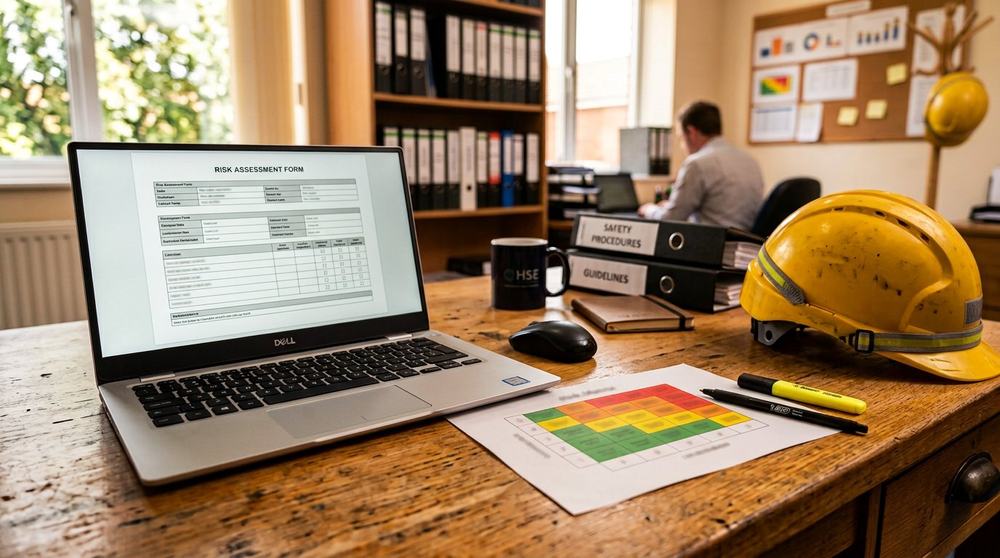
The office risk assessment template is the five-step method aimed at the hazards of the office and the desk workplace: the electrical, the DSE and the ergonomics, the slips on the wet floor, the fire and the escape, and the stress and the working pattern that the office-specific hazards include.

Office Risk Assessment Template — the desk workplace
The office hazards as lines: the DSE, the electrical, the slips, the fire, and the stress and the working pattern. The DSE and the RA are one document.
| Office hazard | Who | L | C | Score | Control | Owner | Due |
|---|
Suggested office lines: the screen at the wrong height (DSE) · the chair without the lumbar (DSE) · the lighting under 500 lux (DSE) · the extended-hours workload (stress) · the slip on the wet entrance · the server rack and the cabling (electrical) · the blocked fire exit · the manual handling of the boxes.
It is the document the small office, the shared floor and the home-office setup need to show the assessment is suitable and sufficient — not the box-ticking version, but the method with the office hazards named. The DSE items are carried as their own lines, so the office assessment and the DSE assessment are one document, not two.
How to use the template
- Set the header — the office or floor, the assessor, the date, the review date
- Work the office hazard lines — electrical, DSE, slips and trips, fire, furniture, and the stress and working pattern
- Name who each hazard can harm — the staff, the visitors, the disabled, the lone worker
- Score likelihood and consequence; the template shows the band
- Write the controls — the monitor arm, the chair, the mat, the RCD — and name the owner and the date
- Sign it, brief the team, print it, and set the review
Worked example
A six-line office assessment: the screen at the wrong height (DSE, 2×3=6, the monitor arm), the fixed chair with no lumbar (2×3=6, the adjustable chair), the slip on the wet entrance (2×3=6, the mat and the drain), the server rack and the cabling (2×3=6, the RCD and the tie), the blocked fire exit (3×3=9, cleared and re-marked), and the extended-hours workload (stress, 2×3=6, the rota review). Six lines, one morning, and the 9 has an owner and a date.
Standard & legal context
The office template is the MHSWR 1999 five-step method applied to the desk workplace, with the DSE lines carrying the Health and Safety (Display Screen Equipment) Regulations 1998 duty and the ISO 9241 ergonomics. The 5×5 scoring is the HSE ACoP L80 convention. The office is where the stress and the working-pattern hazards sit, and the template carries them as lines, because the office-specific risk is as much the pattern as the plug.
Common mistakes
- Assessing the equipment and not the user — the DSE duty is the workstation and the user together, and the template carries both
- One assessment for the whole floor — each workstation and the shared areas are assessed, not the room as a label
- Skipping the stress and the working pattern — the office-specific risk is the hours and the workload, and they are lines, not a footnote
- The static assessment in the static room — the review is on the change of the workstation, the user or the complaint, and at the set interval
Need the sign-off, not just the template?
The template is the preparation; the sign-off is the professional. For the statutory assessments, the audits, the ISO 45001 implementation and the training that comes with them, ask Muhammad Umer — 8+ years across Iraq, KSA and Pakistan, and the programme runs through umer-hse.pro. One message gets the written scope.
Common questions
Office Risk Assessment Template — answered
What is an office risk assessment?
The five-step risk assessment applied to the office and the desk workplace: the electrical, the DSE and the ergonomics, the slips, the fire, and the stress and the working pattern. It is the document the small office needs to show the assessment is suitable and sufficient.
Is an office risk assessment legally required?
In the UK, the MHSWR 1999 require the assessment at any size and the recording at five or more employees; the DSE Regulations 1998 add the workstation and the user assessment where display screen equipment is used regularly. The template covers both.
How is it different from the general risk assessment template?
The same five steps, with the office hazards named as lines — the DSE, the electrical, the slips, the fire, the stress — so the small office can use it without building the table from scratch. The general template is the blank five-step version.
Does it cover the DSE assessment?
Yes — the DSE items are carried as their own lines (the screen, the chair, the desk, the lighting, the breaks), so the office assessment and the DSE assessment are one document. The DSE template on this site is the dedicated version.
Can I use it for a home office?
Yes — the same hazards apply at the desk at home, and the template works for the setup. The employer duty is on the workplace the employee uses, and the home office is included where it is provided or agreed.
Can I print or export it?
Yes — Print / Save as PDF for the file, and Export CSV for the register. The template is built to be done in a morning and filed the same day.
Keep building
Related templates
General Risk Assessment Template
Free risk assessment template you can print and fill in: the 5 steps, the 5×5 scoring, the action plan and the
Toolkit toolDse Assessment
Working HSE tool from the toolkit
Risk Assessment Templates5-Step Risk Assessment Template
The HSE five-step risk assessment as a printable template: identify hazards, who is harmed, evaluate, record,
THE HEALTH AND SAFETY is an education and knowledge network. The templates are free and open; the professional assessments and audits run through umer-hse.pro.
Safety disclaimer
These templates are practical documents, built to the UK baseline with the US equivalents named on each page. They do not replace a competent person assessment for high-risk work, a statutory assessment, or the advice of your insurer. Where a document has legal force — the fire risk assessment, the COSHH register, the permit to work — the responsible person owns it. Use the template as the preparation, and the competent person as the sign-off.